Study Guides· Study
A study guide for your exam, built in seconds.
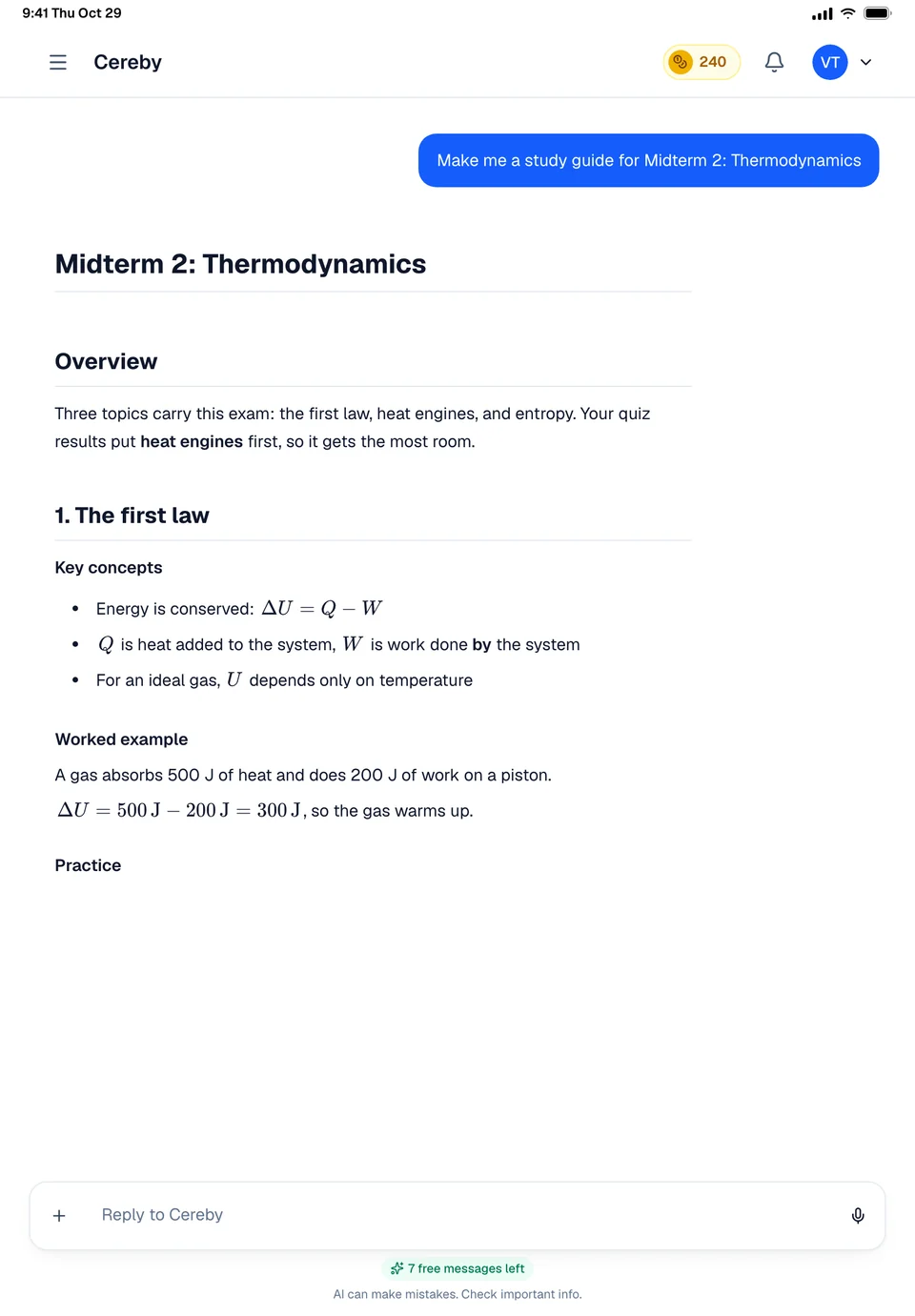
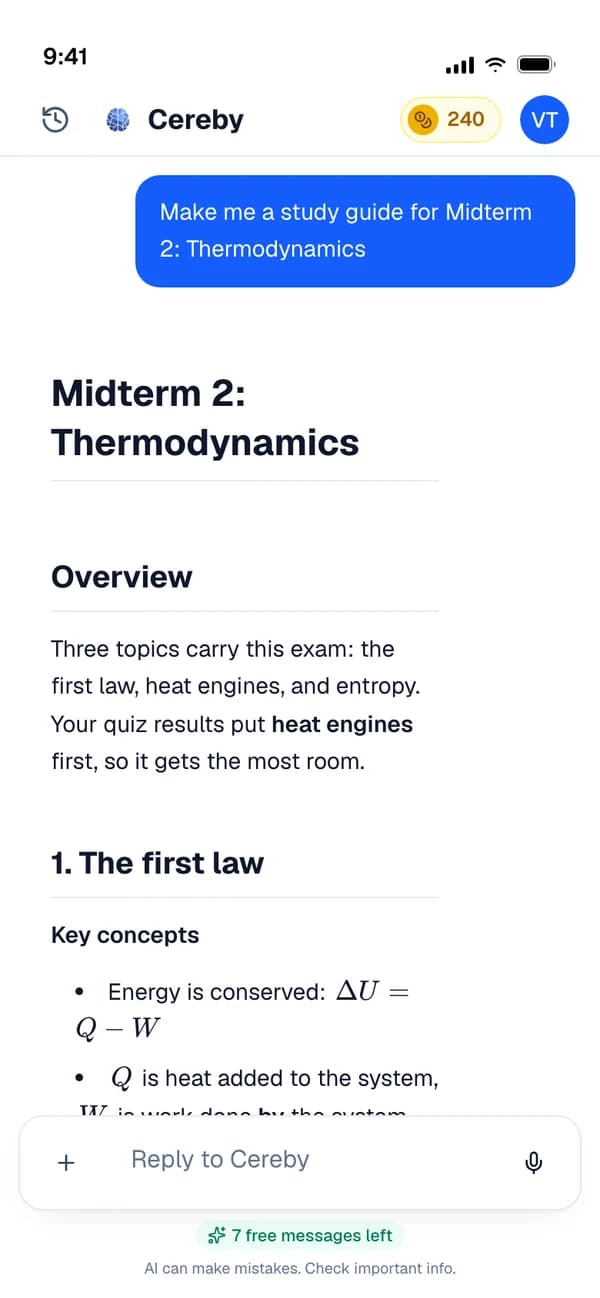
Tell Cereby the subject, the topics on your exam and the date. It writes a focused guide with definitions, worked examples, practice problems and common mistakes, weighted toward your weak spots.


One document to study from before the exam
A good study guide is the thing you wish the professor had handed out: every topic on the exam, the definitions you need, a worked example of each kind of problem and a list of the traps. Making one by hand takes the evening you were supposed to spend studying.
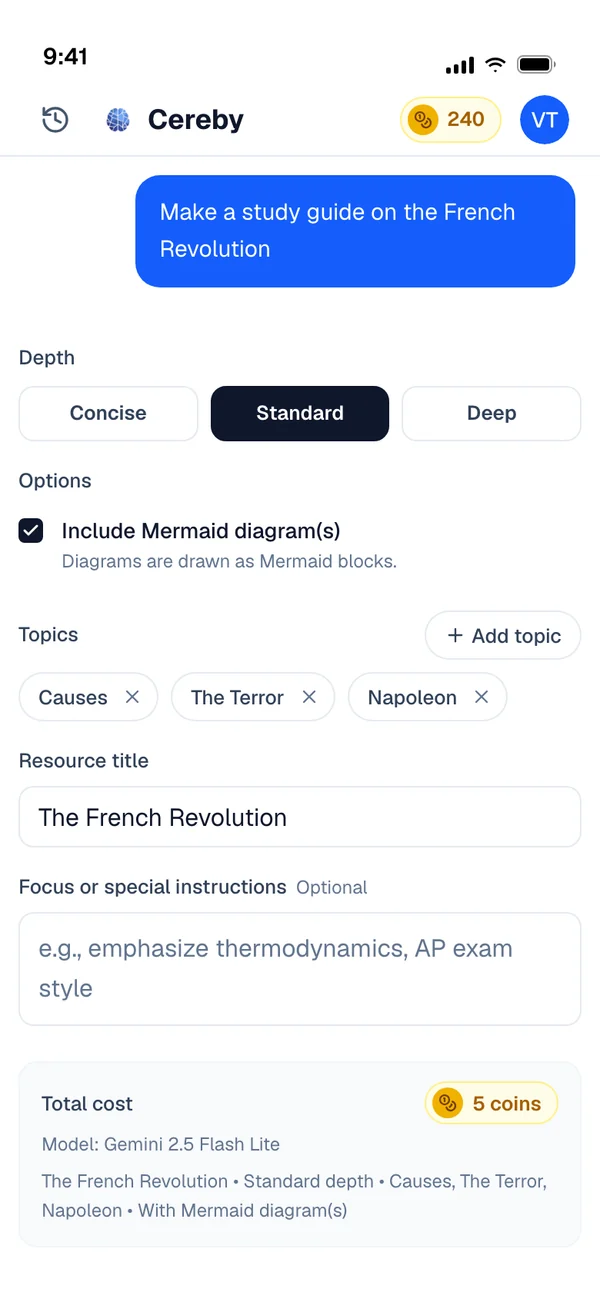
Tell Cereby the subject, the topics the exam covers and when it is. It writes the guide in chat, organized topic by topic, and leans toward the topics your quiz results say you are weakest on. Choose a quick summary, a detailed guide or a comprehensive one, depending on how much time you have left.
- 3 depthsSummary, detailed or comprehensive
- Weak spotsWeighted by your quiz and flashcard results
- WorkedExamples and practice problems for each topic
- In chatAsk follow up questions right under it
An excerpt from a guide
Part of the thermodynamics section from a detailed guide for a general chemistry midterm.
- Key concepts
Enthalpy (H): the heat a reaction exchanges at constant pressure. Negative means heat is released. Entropy (S): how spread out energy and matter are. Gases have more than liquids. Gibbs free energy: ΔG = ΔH − TΔS. A negative ΔG means the reaction runs on its own.
- Worked example
Ice melting at 25 °C: ΔH is positive (it absorbs heat) and ΔS is positive (liquid is more disordered). At 298 K the TΔS term is larger than ΔH, so ΔG is negative and the ice melts.
- Common mistakes
Using °C instead of kelvin for T. Forgetting ΔS is usually in J/K while ΔH is in kJ.
- Exam tip
If a question asks at what temperature a reaction becomes spontaneous, set ΔG to zero and solve for T.
Study Guides in three steps
Name the exam
The subject, the topics on the review sheet and the exam date. Cereby adds the weak spots it already knows about from your quizzes.
Choose the depth
Summary for a last look, detailed for most exams, comprehensive for a cumulative final.
Work through it
Read each topic, try the practice problems before checking the worked examples, and finish with the quick reference page.
Made for weeks like these
A cumulative final
Get one comprehensive guide that covers the whole semester instead of rereading fourteen weeks of slides.
A review sheet with no answers
Paste the professor's list of topics and get the definitions, examples and practice problems that go with each one.
Catching up after missing a week
Ask for a summary level guide on the lectures you missed so you know what to read first.
Study Guides: common questions
If your question isn't here, ask anything in the chat. A real person answers.
Related

Your next exam starts here.
Bring your syllabus. Cereby learns your schedule, tracks what's due and turns every topic into the video, podcast, quiz or deck you'll actually study from. Free to start, no card required.